
Professional & Amiable Guitar Tuition in Leeds. ™
Professional & Amiable Guitar Tuition in Leeds. ™
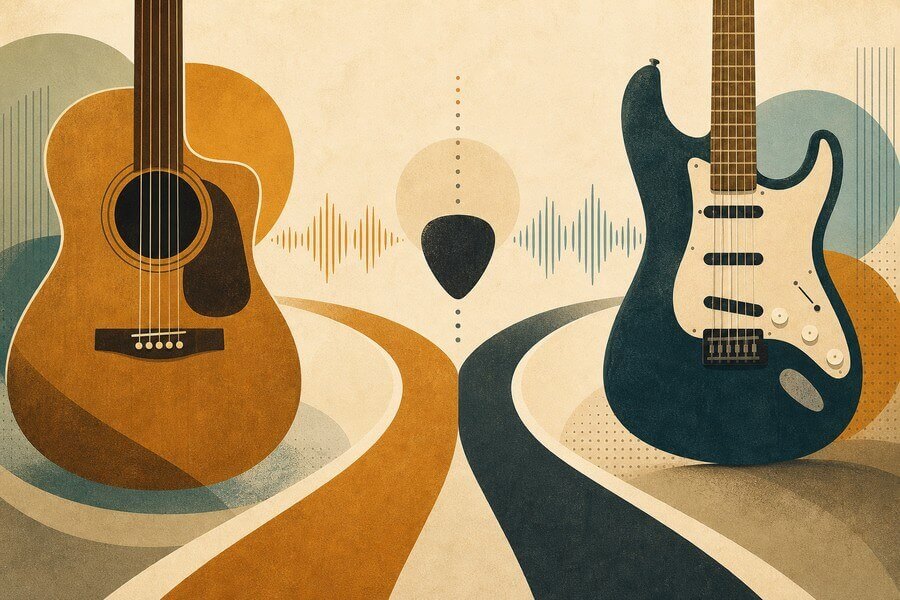
One of the first questions beginners ask is whether they should start on acoustic or electric guitar. It is a fair question, because the choice affects how the guitar feels in your hands, how you practise at home and what music you feel drawn towards.
The honest answer is that either can work. You do not have to earn the right to play electric by starting on acoustic first, and you do not have to choose acoustic just because it looks simpler. The best first guitar is usually the one that suits your music, your hands and your home setup.
If you are booking lessons and feel unsure, a good teacher can help you compare both before you spend money. That is often better than guessing from online reviews.
Many adults were told years ago that everyone should learn acoustic first. The idea was that acoustic guitar builds stronger fingers and gives you proper foundations before moving on to electric.
There is a little truth in the foundation part. Acoustic playing can be brilliant for rhythm, chord changes and clear strumming. But the stronger-fingers argument is not a good reason to make learning harder than it needs to be. Beginners already have enough to think about without fighting a guitar that feels uncomfortable.
If electric guitar is the sound that made you want lessons, starting on electric is perfectly sensible. You can learn chords, rhythm, timing, riffs, scales and good technique on electric from day one.
Acoustic guitar suits players who want a simple setup. You can pick it up, tune it and play without plugging anything in. That makes short practice sessions easier, especially if the guitar is kept nearby at home.
It is a strong choice for singer-songwriter material, folk, pop strumming, country, worship music and plenty of classic songs. If you enjoy the sound of open chords ringing clearly, acoustic lessons can feel very rewarding early on.
The main thing to watch is playability. A steel-string acoustic with high action can make beginner chords feel much harder than they should. A smaller-bodied acoustic or a well-set-up instrument can make a big difference.
Electric guitars are often easier under the fingers. The strings are usually lighter, the neck can feel slimmer and you do not need to press as hard to get a clean note. That can help beginners who worry about sore fingertips or hand strength.
Electric is also the obvious route if you want to play rock, indie, blues, metal, punk, pop lead lines or riffs. Motivation matters. If the guitar sound excites you, you are more likely to practise.
You will need a small amp or headphone-friendly practice setup, but it does not have to be expensive or loud. In lessons, the focus should still be on control, timing and clean playing rather than turning everything up.
Classical guitars have nylon strings and a wider neck. They can feel gentle on the fingertips, which helps some beginners, but the wider neck can feel awkward for others. They are not automatically easier.
A classical guitar is a good fit if you specifically want to learn classical pieces, nylon-string fingerstyle or certain Spanish-influenced styles. If your goal is rock songs or modern pop strumming, acoustic or electric will usually feel more natural.
Sound matters, but comfort matters just as much at the start. If the body is too big, the neck feels like a stretch, or the strings sit too high, practice becomes a chore.
Try to sit with the guitar before buying if you can. Notice whether your picking arm rests naturally, whether your fretting hand can reach basic chord shapes, and whether the guitar stays in tune. These simple checks tell you more than a long list of specifications.
If you are unsure, bring the guitar you already have or ask before buying one. In a first lesson I can usually tell quickly whether an instrument is suitable, whether it needs a setup, or whether another style of guitar might suit you better.
You may also find that your choice changes later. Plenty of players start on acoustic and add electric, or start on electric and later enjoy acoustic. The first choice is not a life sentence.
Choose acoustic if you want a simple grab-and-play instrument for strumming and songs. Choose electric if the music you love is built around riffs, lead parts or amplified sounds. Choose classical if nylon-string music is genuinely what you want to play.
If you are still unsure, do not rush the purchase. Contact me before booking your first lesson and I will help you think it through calmly.
If you've enjoyed this article, please share it!
Save time and learn faster with Mike. If you are based in Leeds, then I would be happy to help you to become your best at playing guitar.
Learn MoreI am a professional guitar teacher based in Leeds, UK. Having taught 500+ regular students over + years, I am confident that I have the relevant experience to help you to achieve your guitar playing goals & dreams.
Give the gift of music with MJP Guitar Tuition. If you are buying lessons as a present for someone, then our gift vouchers are the ideal solution for you. Learn more...

Copyright © MJP Guitar Tuition. All Rights Reserved.