
Professional & Amiable Guitar Tuition in Leeds. ™
Professional & Amiable Guitar Tuition in Leeds. ™
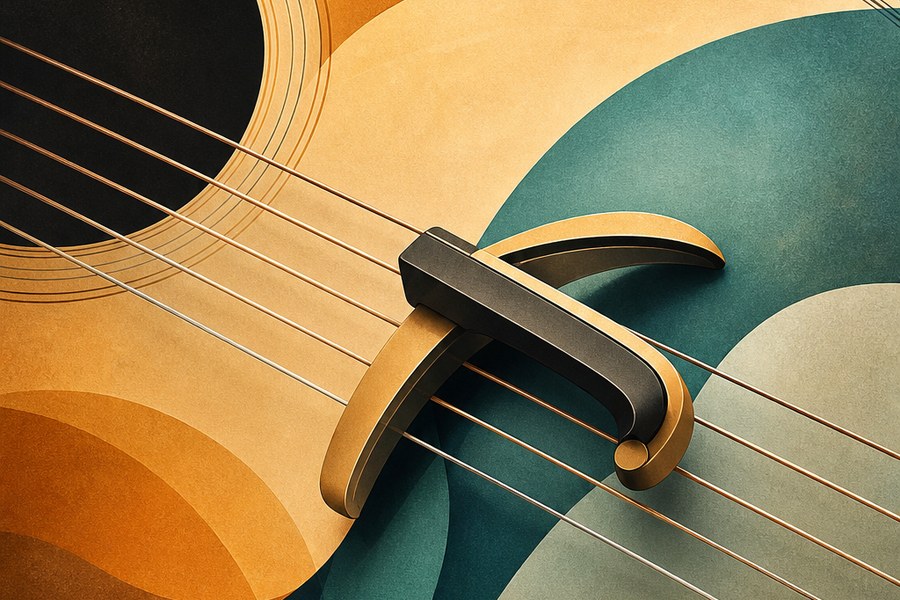
A capo is a small clamp that holds the strings down across a fret. It lets you use familiar chord shapes higher up the neck, which can make songs easier to sing or play.
For beginners, the capo is helpful as long as it is used properly. Put it in the wrong place and the guitar can buzz, sound sharp, or feel more confusing than it needs to.
Place the capo just behind the fret, not halfway between frets and not directly on top of the metal fret. It should press the strings cleanly without pulling them sideways.
After putting it on, strum each string gently. If one string buzzes or sounds dead, adjust the capo before blaming your chord shape.
Some songs use awkward chord shapes in their original key. A capo can let you use friendlier open chord shapes while still sounding in the right key.
This is especially useful on acoustic guitar. You may see instructions like "capo 2" on a song sheet, which means place the capo behind the second fret and play the written chord shapes from there.
A capo is a tool, not a shortcut for everything. You still need to learn clean chord shapes, steady strumming and good timing. If every song feels impossible without a capo, the underlying chord work may need attention.
If chord shapes are the main struggle, play easy guitar chords and what to do when guitar chords sound muted are good companion articles.
Some capos squeeze harder than others. If the pressure is too strong, the strings can go slightly sharp. This is not your imagination. It is worth checking tuning after putting the capo on, especially if you are recording or playing with someone else.
A clip-on tuner makes this easy. The older lesson on how to use your tuner will help if tuning still feels uncertain.
You do not need anything fancy. A reliable spring or trigger capo is fine for most beginners. It should fit your guitar neck comfortably and press all strings evenly.
If you have a classical guitar, check that the capo is suitable for a wider, flatter neck. Steel-string acoustic and electric guitars usually need a different shape.
Try playing the same chord progression with no capo, then with the capo on the second or fourth fret. Listen to how the sound becomes brighter. This is a simple way to understand why songwriters use capos for texture, not just convenience.
If you are choosing between acoustic and electric guitar, acoustic or electric guitar lessons may help you think about the sounds you prefer.
A capo is simple once you know where to place it and when to retune. Use it to make songs more playable, but keep building the chord and rhythm skills underneath.
If a song sheet with a capo marking is confusing you, book a lesson and I can show you how the shapes fit together.
If you've enjoyed this article, please share it!
Save time and learn faster with Mike. If you are based in Leeds, then I would be happy to help you to become your best at playing guitar.
Learn MoreI am a professional guitar teacher based in Leeds, UK. Having taught 500+ regular students over + years, I am confident that I have the relevant experience to help you to achieve your guitar playing goals & dreams.
Give the gift of music with MJP Guitar Tuition. If you are buying lessons as a present for someone, then our gift vouchers are the ideal solution for you. Learn more...

Copyright © MJP Guitar Tuition. All Rights Reserved.