
Intro
Three pedals are enough to teach you most of what matters about pedal order. You can hear how one effect feeds the next, find level jumps quickly and learn which changes suit your own playing. A sensible first chain is compressor, overdrive, then delay, but that order is a starting point rather than a law.
For this lesson, use a clean or lightly driven amp and keep every pedal setting modest. We will connect the chain correctly, test each pedal on its own, match the volume, then swap the drive and delay. The point is to hear the result clearly rather than copy a diagram without knowing why it works.
Follow the signal from guitar to amp
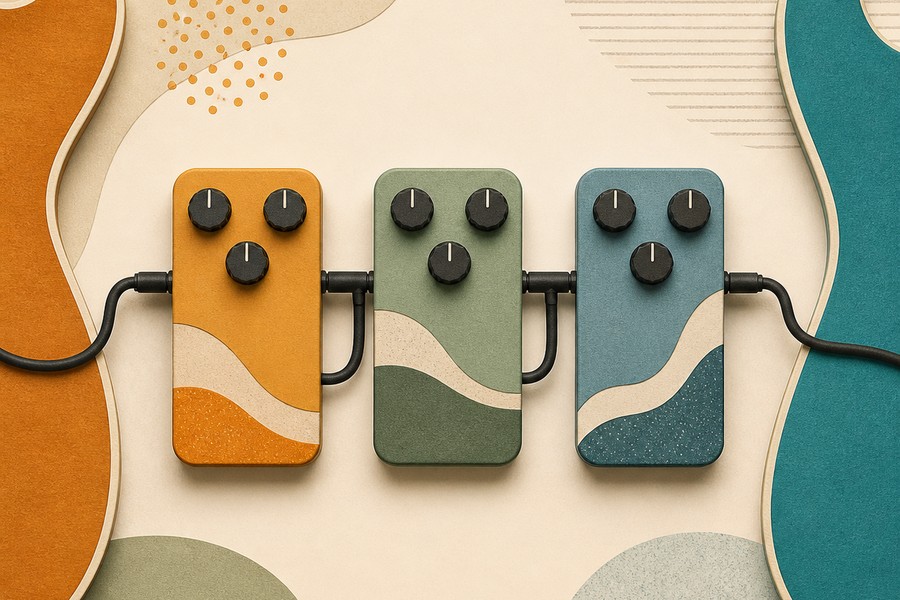
Your basic chain is guitar into compressor, compressor into overdrive, overdrive into delay, and delay into the amplifier input. Think in the direction the signal travels. The guitar creates the signal, each pedal changes what reaches it, and the amp makes the final result audible.
Most standard pedals have INPUT on the right and OUTPUT on the left when viewed from above. Plug the guitar cable into the compressor's input. Use a short patch cable from its output to the overdrive input, another from the overdrive output to the delay input, then run the delay output to the amp. Labels vary, so read the pedal rather than relying on left and right alone.
Connect power before turning the amp up. If you use a shared power supply, check that its voltage, polarity and current suit every pedal. Many compact pedals use 9V DC with centre-negative polarity, but not all do. The wrong supply can damage a pedal. When in doubt, use the maker's specification.
Test every pedal by itself first
Put all three pedals in the chain but switch them off. Confirm that the clean guitar reaches the amp. Then turn on only the compressor. Use a low sustain or compression setting and set its output so the bypassed and active volumes are close. Listen for a steadier note rather than a dramatic squash.
Switch the compressor off and test the overdrive alone. Start with gain low, tone around the middle and level turned down before you engage it. Bring the level up until the sound is roughly as loud as your clean signal. Repeat with the delay: choose a short or medium delay time, two or three audible repeats and a low mix.
If one pedal produces silence, remove it and reconnect the guitar straight to the amp. Then add that pedal with one known-good cable on each side. This simple isolation test is quicker than turning every knob at once. For a broader guide to effect types, read guitar effects explained.
Set a matched working volume
A pedal can sound more exciting simply because it is louder. That makes order comparisons misleading. Set the amp to a comfortable room level, play the same short chord or riff, and adjust each pedal's output while switching it on and off. Aim for a similar perceived volume unless you deliberately want the overdrive to provide a boost.
- ❯ Begin with every pedal bypassed and note your clean volume.
- ❯ Engage one pedal at a time while playing the same phrase.
- ❯ Adjust output or level before changing tone, gain or repeats.
- ❯ Test combinations only after each pedal works on its own.
- ❯ Write down knob positions that give you a balanced starting sound.
Compression makes this slightly harder because it changes the attack and average loudness. Set it by ear at the way you normally pick, not with unusually hard test strums. If the compressor is new to you, this beginner compressor pedal guide covers threshold-style behaviour, sustain and noise in more detail.
Why compressor, drive and delay often work in that order
A compressor first receives the guitar's widest dynamic range. It evens out strong and soft notes before they reach the overdrive, which can make the amount of drive more consistent. This is useful for clean picking and mild overdrive. It can also raise background noise, so keep sustain conservative and switch it off when it is not helping.
The overdrive then adds clipping and harmonic content. Placing delay after it means the delay copies the already-driven sound. Each repeat keeps the basic character of the original note and fades in a fairly orderly way. That is why drive before delay is the common beginner setup.
For a first delay sound, try about 300 to 400 milliseconds, two or three repeats, and a mix low enough that the dry note stays in front. Exact knob positions depend on the pedal. The lesson on how to use a delay pedal for guitar gives you musical exercises for timing repeats against a steady pulse.
Swap drive and delay on purpose
Now switch off the amp or turn its volume right down before moving cables. Reconnect the chain as guitar, compressor, delay, overdrive, amp. Restore the same settings and play the same phrase you used before.
With delay before overdrive, the dry note and its repeats all hit the drive circuit. As they overlap, the overdrive clips and compresses the combined signal. The repeats may feel thicker, less separate and more congested, especially with higher feedback. Picking a new note can also push an older repeat into more distortion.
That sound is not wrong. It can suit short slapback delay, noisy textures or parts where you want the echoes to merge into the drive. Lower the delay mix and feedback if the result becomes untidy. Then return to drive before delay and notice how the repeats sit behind the original note more clearly. The useful lesson is the audible difference, not which diagram wins.
Include the amplifier in your decisions
Pedals do not operate in isolation from the amp. If the amplifier's preamp is heavily distorted, a delay plugged into the normal input is effectively feeding repeats into more distortion, even when the delay sits last on your board. An amp effects loop, where available, lets you place delay after the amp's preamp distortion. For a first setup, a clean amp input keeps the test easier to hear.
Start with bass, middle and treble near noon, keep built-in effects off, and avoid excessive gain. Once the pedal chain is balanced, adjust the amp to suit the room and guitar. Beginner electric guitar amp settings will help if the controls are masking what the pedals are doing.
There are many sensible exceptions to conventional order. Some players put a wah before fuzz, others prefer it after. A volume pedal behaves differently before and after drive. Modulation can sit before drive for a blended sound or after it for a more obvious sweep. Change one connection at a time, keep the levels matched and use the same musical phrase. That gives your ears a fair comparison.
Outro
Build the compressor, overdrive and delay chain carefully, then spend ten minutes swapping the last two pedals. Once you can describe what becomes clearer, thicker or noisier, pedal order stops being a rule to remember and becomes a sound choice you can make.
If you've enjoyed this article, please share it!
Guitar Lessons In Leeds
Save time and learn faster with Mike. If you are based in Leeds, then I would be happy to help you to become your best at playing guitar.
Learn More